Second Round of Funding: Energy Conversion and Storage (2023–2025)
Title: Hybrid Modeling of Intensified Continuous Power-to-X Processes
Award: Satell UConn-Technion Global Energy Research Project
PIs: Prof. Burcu Beykal (UConn) and Prof. Michael Patrascu (Technion)
Period: TBC
Total Amount Awarded: $40,000
Abstract: The utilization of CO2 as a feedstock for chemical processes has emerged as a promising avenue for mitigating greenhouse gas emissions and promoting sustainable energy solutions. Our research collaboration between the Technion and UConn teams aims to advance the modeling and optimization of integrated processes based on membrane reactors for CO2 utilization, leveraging cutting-edge techniques in machine learning and hybrid modeling.
Project Outcomes
Year 1 (July 1, 2023 – June 30, 2024)
- The UConn team successfully applied Physics-Informed Neural Networks (PINNs) to model the reverse water-gas shift (RWGS) reaction in membrane reactors. The PINN model demonstrated exceptional predictive accuracy. By shifting the equilibrium reaction forward, it identified conditions that enhance CO2 conversion and CO yield, thereby lowering operating temperatures.
- The Technion team derived a 1D membrane reactor model to predict the performance of the RWGS reaction under various conditions. Significant increases in conversion were achieved compared to equilibrium limitations in traditional reactors.
- The Technion team developed a detailed permeance model that predicts the temperature, pressure, and composition dependency of water permeance and selectivity. This model has been incorporated into the membrane reactor model to improve performance predictions.
- A joint proposal was submitted to the National Science Foundation–Binational Science Foundation (NSF-BSF) program in December 2024.
Conference Presentations
- AIChE Conference, November 2024 – Collaborative presentation on a simplified 1-D isothermal reactor model.
- Abstract submitted to the European Symposium on Computer-Aided Process Engineering (ESCAPE 35), July 2025 – DeepONets and 2-D reactor modeling.
Title: Novel Protein-based Proton Exchange Membranes for Application in Next Generation Fuel Cells and Water Electrolyzers
Award: Satell UConn-Technion Global Energy Research Project
PIs: Prof. Stoyan Bliznakov (UConn) and Prof. Nadav Amdursky (Technion)
Period: July 1, 2023 – June 30, 2025 (TBC)
Total Amount Awarded: $40,000
Project Outcomes
Year 1 (July 1, 2023 – June 30, 2024)
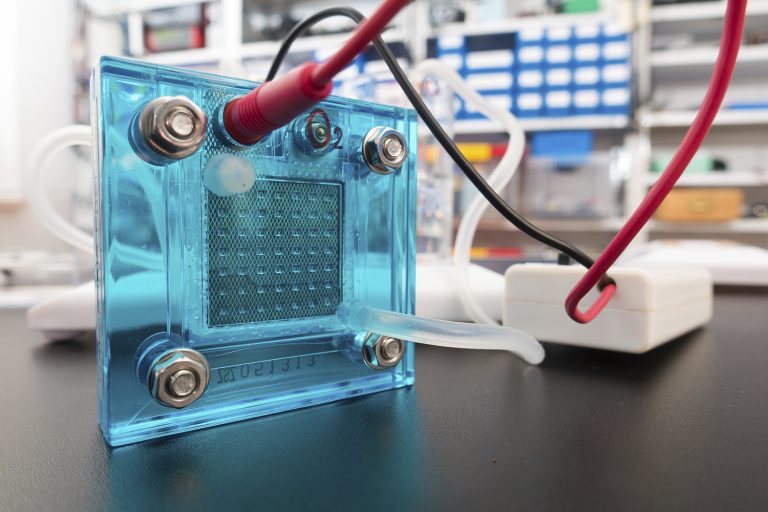
- Multiple protein-based proton conducting membranes were synthesized and characterized. The UConn team first established baseline performance with Nafion membranes and then assessed the protein membranes' performance in fuel cell and electrolyzer modes.
- Tested and developed a new generation of plant-derived protein-based polymers.
Title: Understanding and Controlling Photoconductivity for Next-Generation Solar-Cell Materials
Award: Satell UConn-Technion Global Energy Research Project
PIs: Prof. Bryan Huey (UConn) and Prof. Yachin Ivry (Technion)
Period: July 1, 2023 – June 30, 2025 (TBC)
Total Amount Awarded: $40,000
Abstract: The primary objective of this effort is to investigate fundamental transport mechanisms in next-generation photovoltaics, leveraging the unique and complementary capabilities at our respective labs at the Technion and UConn.
Project Outcomes
Year 1 (July 1, 2023 – June 30, 2024)
- Dr. Bliznakov's group at C2E2 is responsible for MEA fabrication and assessment of performance in both fuel cell and electrolyzer conditions using a 5 cm² single-cell configuration.
- The Technion team designed and built a setup that adds a probe station to the AFM, enabling in-situ electrical probing, electrical biasing during AFM measurements, and detection of thermoconductance and related properties.
Publications
- L. A. Ortiz-Flores et al., Photoconductivity Mapping in Engineered MAPbI3 Thin Films Engineered for Carrier Selectivity, expected to be submitted to Nano Letters during summer 2024.
First Round of Funding: Fuel Cells (2018–2022)
Title: Highly Stable and Active PEM FC Cathode Catalyst with a Protective Nitride Coating
Award: Satell UConn-Technion Global Energy Research Project
PIs: Prof. Jasna Jankovic (UConn) and Prof. Yair Ein-Eli (Technion)
Period: July 1, 2018 – December 31, 2020 (2-year project with a six-month no-cost extension)
Total Amount Awarded: $60,000
Abstract: The project sought to improve the stability of commercial Pt/C catalysts by applying corrosion-resistant, conductive, and hydrophobic nitride coatings while maintaining catalytic activity.
Project Summary
The goal of the project was to improve the durability of Pt/carbon catalysts in polymer electrolyte fuel cells through selective deposition of corrosion-resistant transition metal nitride coatings using atomic layer deposition (ALD). Another objective was to strengthen collaboration between UConn and Technion and identify future external funding opportunities.
Project Outcomes
Year 1 (July 1, 2018 – June 30, 2019)
- Selective coating of Pt by Oleylamine (OAm) on model graphite electrodes was achieved.
- Yair Ein-Eli visited UConn in September 2018 for project meetings, lab visits, and a seminar.
- A proposal was submitted to the BSF in November 2018.
Year 2 (July 1, 2019 – June 30, 2020)
- Methods developed on model graphite electrodes were applied to Pt/carbon powder catalysts.
- UConn hosted an international workshop on Advanced Manufacturing and Characterization of Fuel Cells and Electrolyzers.
- Technion student Mor Kattan visited UConn to work on catalyst optimization.
- COVID-19 disruptions led to extension of the project through December 2020.
Project Extension (July 1, 2020 – December 31, 2020)
- Optimization of OAm and TiN ALD deposition continued.
- One Master's thesis was defended by Mor Kattan.
- Two publications were submitted.
- A proposal was submitted to NSF-BSF.
Post-Project (January 1, 2021 – January 18, 2022)
- Mor Kattan's Master's thesis was completed.
- A revised NSF-BSF proposal was submitted and received strong reviews.
Publications
- O. Godoy et al., Synthesis and Characterization of Platinum on Carbon Nanoparticles Selectively Coated with Titanium Nitride (TiN), ECS Transactions, Volume 104, Number 8 (2021).
Conference Presentations
- ECS Conference, Orlando (virtual), October 2021.
- World Fuel Cell Conference, Montreal (virtual), August 2021.
- Fall MRS Meeting, Boston (virtual), November–December 2021.
We thank the Satell Family Foundation, the Maurice G. Gamze Endowed Fund, Larry Pitt and Phyllis Meloff, and the Eileen and Jerry Lieberman UConn/Israel Partnership Fund for their generous support.
Title: SOFC Cathode Poisoning from Airborne Impurities: Mechanism and Mitigation
PIs: Prof. Prabhakar Singh (UConn) and Prof. Yoed Tsur (Technion)
Period: July 1, 2018 – Ongoing
Total Amount Awarded: $60,000
Abstract: The collaborative research program focuses on mitigating SOFC cathode poisoning caused by airborne impurities and developing multifunctional getter materials to improve long-term electrochemical performance.
Publications
As of January 2022, the collaborative program focused on technical discussions related to airborne trace contaminants and their removal using cost-effective getters. A manuscript titled 3-Dimensional Foam to Capture Contaminants from Air and Interconnects in Solid Oxide Fuel Cells was under review.
Title: NiM-CeOx/C Catalyst Synthesis and Characterization
PIs: Prof. Radenka Maric (UConn) and Prof. Dario R. Dekel (Technion)
Period: July 1, 2018 – December 31, 2021
Total Amount Awarded: $75,000
Abstract: This project focused on developing advanced catalysts for anion exchange membrane fuel cells (AEMFCs) to improve hydrogen oxidation reaction (HOR) performance and reduce dependence on platinum-based materials.
Project Outcomes
- The team achieved hydrogen oxidation reaction performance superior to many published benchmark catalysts.
- Funding was extended to support continued work through the end of 2022.
Publications
- Haoran Yu et al., Palladium-Ceria Nanocatalyst for Hydrogen Oxidation in Alkaline Media: Optimization of the Pd-CeO2 Interface, Nano Energy, 2019.
- Sanjubala Sahoo et al., Atomistic Insights into the Hydrogen Oxidation Reaction of Palladium-Ceria Bifunctional Catalysts for Anion-Exchange Membrane Fuel Cells, ACS Catalysis, 2021.
- Zhiqiao Zeng et al., Advanced Nickel-based Catalysts for the Hydrogen Oxidation Reaction in Alkaline Media Synthesized by Reactive Spray Deposition Technology, submitted to International Journal of Hydrogen Energy, 2024.
Conference Presentations
- Haoran Yu et al., 235th Electrochemical Society Meeting, Dallas, Texas, May 2019.
- Sanjubala Sahoo et al., 240th Electrochemical Society Meeting, Orlando (online), October 2021.