‘When international law meets Geopolitics, the case of the Chagos Archipelago’
November 18, 2026 | Sara Mahmoud, UConn Global Affairs
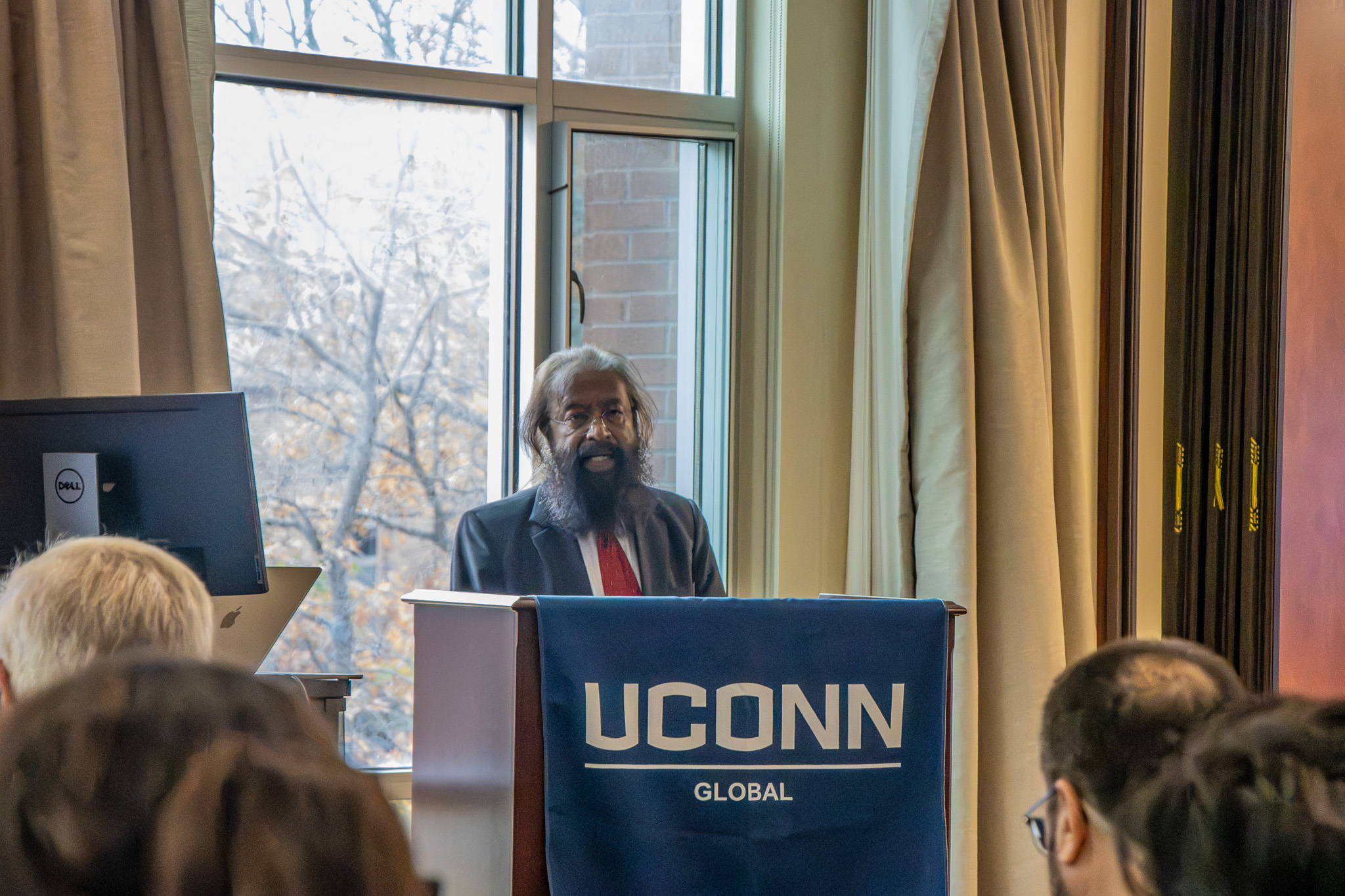
Ambassador Jagdish Koonjul, former Permanent Representative of Mauritius to the United Nations, visited UConn on Thursday, Nov. 5, for a lecture on the history of the Chagos Archipelago, its significance in the Indian Ocean, and the experiences of the Chagossian community.
The lecture, titled “When International Law Meets Geopolitics” was hosted by the Office of Global Affairs and offered students and faculty a look at a lesser-known chapter of modern history. Drawing on his diplomatic career, Koonjul traced the separation of the islands from Mauritius and the decades of international engagement that followed.
An Archipelago with a Contested Past
Located in the Indian Ocean, the Chagos Archipelago has long been tied to Mauritius. In 1965, the United Kingdom separated the islands from Mauritius, three years before the country gained independence.
The archipelago later gained strategic importance during the Cold War, largely because of the military base on Diego Garcia. Building it changed the life for those who lived on the islands. Koonjul described the experiences of Chagossians, many of whom were displaced from their homeland and resettled in Mauritius, the United Kingdom, and Seychelles.
Law, Diplomacy, and International Institutions
A central theme of the lecture was the role international institutions can play in resolving long-running disputes. Koonjul discussed Mauritius’ engagement with the United Nations and the International Court of Justice, and how those bodies give countries a forum to present their positions, pursue dialogue, and seek peaceful solutions.
He also addressed the negotiations between Mauritius and the United Kingdom and the agreement the two countries signed in May 2025 on the archipelago’s future. The agreement outlines proposed arrangements for the islands, including the continued operation of the military facility on Diego Garcia and provisions for the Chagossian community. It has not yet entered into force, and discussions about its implementation continue.
Through these examples, Koonjul showed how international relations blend historical context, diplomacy, security concerns, and cooperation among nations.
Preserving Chagossian Heritage
The lecture also turned to the people at the center of the story. Displacement has affected Chagossian families across generations, and questions of identity, cultural traditions, and historical memory remain central to the conversation about the community’s future. The discussion underscored the importance of including community voices in decisions about the archipelago.
UConn’s Connection to Mauritius
The event also highlighted UConn’s own ties to Mauritius through Dimitris Xygalatas, a professor in the Department of Anthropology, who has conducted research there since 2009 and brought numerous UConn students to the island. He is currently working with the Chagossian community to document its history, traditions, and cultural heritage.
“The experience of the Chagos Islanders is a compelling and often overlooked chapter in modern history,” said Xygalatas. “As someone who has been doing research in Mauritius since 2009, who brought numerous UConn students to the island, and who is currently working with the Chagossian community, I was thrilled to have the Ambassador speak to us on this issue of international importance.”
Through oral-history and cultural documentation projects, Xygalatas and his collaborators work alongside community members and Mauritian research assistants to record life histories, traditions, and memories, particularly those of older generations. The work preserves vital cultural knowledge while connecting UConn students and researchers with people in Mauritius.
Learning From Those Most Affected
The lecture gave students and faculty the chance to hear directly from an experienced diplomat and to see how history, culture, and international relations intersect. It also underscored the value of understanding global issues through the eyes of the communities most directly affected.
“It is a privilege to welcome Ambassador Koonjul to UConn and to host this important lecture,” said Ngozi Taffe, Interim Vice President for Global Affairs. “UConn’s growing research and student mobility engagement in Mauritius exemplifies the value of international collaboration. Working alongside Dimitris in support of these efforts has been a rewarding experience, and this lecture offered an excellent opportunity to showcase that work while exploring the role of diplomacy in addressing global challenges.